Sunday, April 18, 2010

The Final Hours

Hale comes back to Salem after a few months visit to other villages. He desperately wants to save the accused that have yet to confess. Hale goes as far to ask the court to pardon the lives of the accused. At this point in the novel, Hale is tremendously worried about Proctor and Rebecca Nurse. Hale believes that if any more people die, it will be his fault. Hale believes he has taken on the “devil’s work,” meaning he has come to Salem to convince the accused to lie and say that they have seen the Devil.
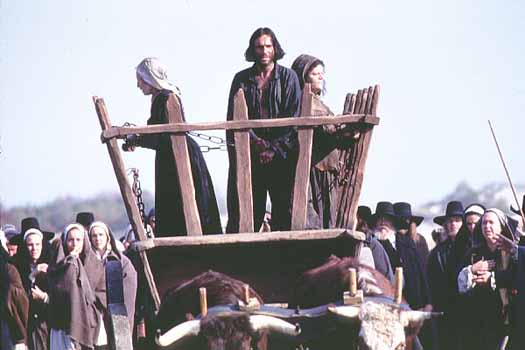
Hale obviously fails to convince anyone to confess because in the end, they are all hanged. The death of Proctor left mound of guilt on Hale and the others who participated in the witch-hunt. Although Hale tried to prevent the death of the accused, he was a late upon the revelation that the accusers were the guilty ones.
The Truth is Revealed

Reverend Hale goes into court hoping to find the real truth of the matter. When Hale realizes that Giles is innocent, Hale tries to persuade the court by stating “he clams hard evidence” on behalf of Giles. Though, the court seems not to take into consideration of his opinion. While the court is in session, Hale continues to testify on behalf of the accused that will not confess. He is now unconditionally against the belief of witchcraft in Salem. Hale even says he regrets signing away the death warrants of some of the accused.
Hale attempts to save the life of John Proctor by saying, “It is a natural lie to tell; I beg you, stop now before another is condemned! I may shut my conscience to it no more—private vengeance is working through this testimony! From the beginning this man has struck me true. By my oath to Heaven, I believe him now, and I pray you call back his wife before we--.” As the climax build up, Hale comes to realize that the accused are only being accused because there are many personal matters within the city that do not have to do with religion, but instead, have to do with personal grudges. Now, since the court has essentially made their final decision, the accused will be hanged, Hale is in a dilemma: either he must convince the accused of confessing a lie or must allow them to die as innocent prisoners.

John Hale, a Change in Heart


In Act 2 of The Crucible, Hale investigates the ones being accused of witchcraft. He goes to various houses to talk to the families and to understand why some are accused. When Hale goes to see the Proctor family, he comes upon a revelation. Hale talks to John and Elizabeth; he asks them to list the Ten Commandments. Unlike Goody Osborne, who didn’t know any of her Commandments and was accused of witchcraft, John was able to name nine of the ten, and Elizabeth was able to name the last one. Ironically, the one that John could not recall was “thou shall not commit adultery,” which was the one he committed with Abigail.
Within a few minutes, Elizabeth is arrested for accusations of witchcraft. During Hale’s encounter with John, John said two things that affected Hales belief in the presence of witchcraft. John said that if the accused did not confess, they would always be hanged, but if they did confess, they would not be hanged. He also asked Hale, “Why do you never wonder if Parris is innocent, or Abigail? Is the accuser always holy now? I’ll tell you what’s walking Salem—vengeance is walking Salem.” By John saying such, Hale comes to believe that that the accused may in fact be guilty themselves. However, by now, Hale also understands that the decisions of the trials are out of his power, and he may not be able to influence the decisions the court makes.

Saturday, April 17, 2010

The Arrival of Reverend Hale

When Hale arrives to Salem, there are already a plethora of accusations towards various people in the city. Since Hale claims to be a specialist in finding the bewitched, Parris invites him deal with the possible witches in the city. Upon his arrival, Parris tells Hale of the women and girls caught dancing in the forest, which, at the time, was believed to be a clear sign of witchcraft. Hale does not want to jump to conclusions and accuse the dancing women of witchcraft, but Parris and the Putnams deliberately state that the witchcraft has obviously affected many people. Paris continually tries to persuade Hale of the presence of witchcraft by showing him Betty, the young daughter of Parris, who doesn’t speak a word and stays in bed all day.
At this point in the novel, Hale is a very proud Reverend. Hale appears to be a pious intellectual and doesn’t seem to be easily convinced. His approach to finding the bewitched is finding evidence of their terrible actions, which he is currently having trouble with. Hale is not quick to judge, for he believes that the court will make just decisions in the proceedings.